Why a Kosher-Certified Facility Doesn't Automatically Make Your Product Kosher
A question we hear surprisingly often is:
"Your facility is already Kosher certified. Doesn't that mean our product will be Kosher too?"
We wish it were that simple. Working with a Kosher-certified manufacturer gives a brand an important head start, but it doesn't automatically make every formula, every raw material, or every finished product Kosher certified. And this is usually where first-time Kosher projects become more complicated than expected.
The formula may look completely harmless. No pork. No shellfish. No obviously non-Kosher ingredients. Every raw material may already be approved through the manufacturer's normal GMP supplier qualification program.
Then the Kosher review begins. Suddenly we're looking at the certification status of individual ingredients, manufacturing locations, processing aids, flavors, carriers, and sometimes even changes that Purchasing considered completely routine. The product didn't change. The specification may not have changed. But from a Kosher certification standpoint, the source matters.
At 4Excelsior, our Kosher certification program is administered through cRc Kosher, and one lesson has become very clear over the years:
"The ingredient is the same" and "the ingredient is still Kosher-approved" are not always the same statement.
The Formula Is Only Half the Story
When a brand sends us a new formula, the first instinct is naturally to look at the ingredient names. That makes sense. Some ingredients immediately raise obvious questions. Others look completely routine.
But Kosher certification isn't based solely on what appears in the Supplement Facts panel or ingredient statement. The source and manufacturing conditions behind an ingredient can matter just as much as its name.
A flavor is a good example. "Natural Flavor" may occupy one line on a formula, but the material itself can contain numerous components supplied through a much more complicated manufacturing chain. The same issue can appear with glycerin, emulsifiers, enzymes, oils, release agents, carriers, vitamins, and other processed ingredients.
That's why we don't like assuming an ingredient is acceptable simply because we've used something with the same name before. For certification purposes, the paperwork behind the material matters. Sometimes a lot.
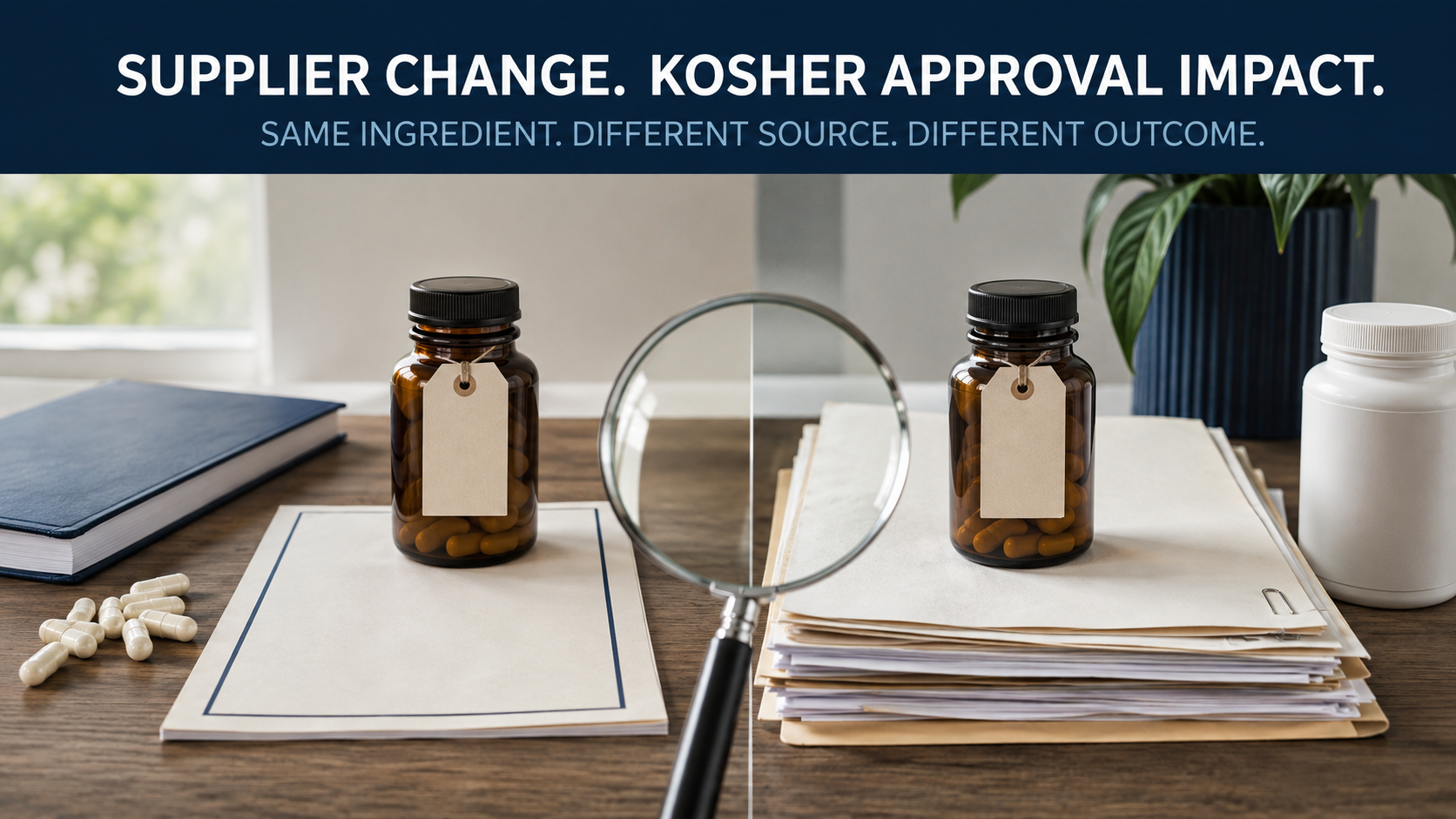
Your Supplier Changed. Did Anyone Tell Kosher?
This is one of those problems that looks small until it isn't. Purchasing finds another supplier. The material meets the same specification. QC reviews it. Pricing is better. Lead time is better. From a normal supply-chain perspective, everyone is happy.
But a Kosher-certified product introduces another question:
Was the new source approved for the Kosher program?
The ingredient name may be identical. The specification may be nearly identical. The manufacturing performance may be identical. That does not automatically mean the certification status follows.
The new supplier may use a different manufacturing site. Its Kosher certificate may cover a different product code. Its certification status may have changed. Or the material may simply not be included in the facility's approved Kosher program yet.
This is why seemingly routine substitutions can create disproportionate headaches. The worst time to discover this is after the material is already sitting in the warehouse and Production is asking why QA hasn't released it. At that point, nobody cares that the PO was cheaper. Everyone cares that the batch can't start.
A Kosher Certificate Is Not a Blank Check
Another misunderstanding we occasionally encounter is the idea that once a manufacturing facility becomes Kosher certified, anything produced there can carry a Kosher claim. It doesn't work that way.
A facility certification establishes the framework. The approved products, ingredients, processes, and conditions behind that certification are what make the framework work.
This distinction matters for contract manufacturers because we may manufacture hundreds of different products for many different customers. Some are Kosher. Some aren't. Some formulas are eligible but haven't been added to the certification program. Others may contain an ingredient that requires additional review.
So when a customer asks:
"Is your facility Kosher certified?"
The answer may be yes. But the next question should always be:
"What does my product need in order to be covered?"
That second question is usually much more useful.
The Tiny Ingredient That Can Stop the Entire Batch
People naturally spend the most time reviewing major ingredients. If a powder contains several kilograms of protein, that's where everyone's attention goes. The ingredient used at a fraction of a percent doesn't feel important.
Kosher review doesn't care how much you paid for it. We've seen certification discussions spend more time on a minor component than on the primary ingredient in a formula. Why? Because risk isn't measured by serving weight. A small amount of flavor, processing aid, carrier, lubricant, or other component can still affect the certification status of the finished product.
That's why one of the most dangerous assumptions in certification work is:
"There's barely any of it."
From a formulation perspective, that may matter. From a certification perspective, sometimes it doesn't matter at all. One unresolved ingredient is still unresolved.
Shared Equipment Is Where Paperwork Meets Reality
Contract manufacturing creates another challenge. Equipment gets shared. A blender that runs a Kosher-certified product today may run a completely different formula tomorrow. The same applies to encapsulation, tablet compression, packaging, and other manufacturing operations.
This is where certification stops being an ingredient exercise and becomes an operational one. What ran previously? What materials were involved? What cleaning occurred? Is there a special restriction associated with the next product? Do the production records support what actually happened?
A good Kosher program has to survive the production floor. It can't exist only in QA's certification folder. That's why we treat production planning, cleaning, material controls, and change management as part of certification—not as separate activities that happen to sit next to it.
The certificate may live in an office. Kosher control doesn't.
Dairy, Pareve, and the One Word That Can Change the Conversation
For many supplement brands, one of the first terms they encounter during Kosher certification is Pareve. And this is where seemingly simple formulation decisions can become important.
A product's Kosher status isn't only about whether it is generally "Kosher." Its classification can matter too. Ingredients and manufacturing conditions can affect whether a product qualifies as Pareve or carries another designation. This becomes especially relevant for brands that want a particular status for market positioning or consumer expectations.
It's much easier to discuss that requirement while the product is still being developed. It's much harder when the brand has already designed packaging around an assumption that nobody confirmed.
We see the same pattern across almost every certification program: Marketing thinks the logo is the final design element. QA knows the logo is the result of everything that happened before it.
Don't Print the Kosher Symbol Because "We're Pretty Sure"
This one sounds obvious. It still happens. Artwork timelines move fast. Marketing wants packaging completed. Purchasing wants labels ordered. Production wants materials available. And certification review suddenly becomes the annoying thing standing between everyone and the print button.
That's exactly when mistakes happen. A Kosher symbol shouldn't be added because the formula looks acceptable. It shouldn't be added because the manufacturing facility is certified. And it definitely shouldn't be added because a previous version of the product had one.
The product needs to be appropriately covered under the certification program, and the artwork needs to use the applicable certification mark correctly. At 4Excelsior, that means coordinating the product and label requirements through our cRc Kosher certification program before treating the claim as final.
Printing first and asking questions later is one of the most expensive ways to handle certification. A PDF is easy to change. Ten thousand printed labels are less cooperative.
Why Kosher Projects Get Stuck Even When Nobody Did Anything "Wrong"
Not every certification delay comes from a mistake. Sometimes everyone followed their own procedure correctly. That's actually what makes these situations frustrating.
Purchasing approved the supplier. QC approved the specification. R&D approved the formulation. Production scheduled the batch. The customer approved the artwork. Every department did its job. And the project can still stop because nobody asked the certification question early enough.
This is something we've learned repeatedly across Kosher, Halal, Organic, and other certification programs. Compliance requirements don't always fit neatly into one department. They sit between departments. That's where gaps happen.
A strong certification program isn't just about having stricter QA review. It's about making sure the right question gets asked before the project reaches the point where changing the answer becomes expensive.
Why We Work With cRc Kosher
At 4Excelsior, our Kosher certification program is administered through cRc Kosher. For us, the value of working within an established certification program isn't simply being able to show customers a certificate. The real value appears during everyday manufacturing.
A customer introduces a new product. A supplier changes. A raw material needs to be reviewed. A new label is being prepared. A certification question appears that doesn't have an obvious answer. Those are the moments when having an established program matters.
It gives us a defined framework for determining what needs review rather than relying on assumptions. And assumptions are usually where certification projects get into trouble.
The goal isn't to make every project more complicated. It's to identify the things that actually matter before they become production problems.
Kosher Certification Is Becoming a Market-Access Question
For some brands, Kosher certification begins as a consumer preference. For others, it's driven by a retailer, distributor, customer, or export opportunity. Either way, the business conversation has changed.
Certification marks increasingly function as shortcuts for trust. A consumer standing in front of a shelf isn't going to investigate the manufacturing origin of every flavor component in a supplement. A retailer qualifying a new brand doesn't want to reconstruct that supply chain either. Recognized third-party certification helps answer those questions.
That's why brands often begin thinking about Kosher certification much earlier as they expand distribution. The important part is making sure certification strategy grows with the product. Adding it after the supply chain, formula, and artwork have already been locked down can turn a relatively manageable review into a much larger project.
The Best Kosher Project Is Usually the Boring One
This might sound strange, but from a QA perspective, a boring certification project is a good project. No emergency supplier emails. No questionable ingredient discovered two days before production. No artwork already sitting at the printer. No last-minute request to approve a substitute raw material.
Everything was reviewed early. The materials were acceptable. The product was properly added to the program. Production knew what it was running. The label was approved before printing. Nothing exciting happened.
That's exactly the point. Good certification work often looks uneventful from the outside because the problems were handled before they became visible. We'd much rather have a boring Kosher project than an interesting one.
Planning a Kosher-Certified Supplement?
If Kosher certification is part of your retail, export, or brand strategy, tell your manufacturer before the formula and packaging are locked. Early review gives us time to evaluate ingredient sources, certification documentation, manufacturing considerations, and artwork requirements while changes are still relatively easy to make.
Contact the 4Excelsior QA & Compliance Team to discuss your cRc Kosher project and request our Kosher Certification Readiness Checklist.
Because "we already ordered the material" is never the sentence you want to hear immediately before discovering a certification problem.
Conclusion
Kosher certification looks simple when all you see is the symbol on the finished package. Manufacturing it is different. Behind that symbol is a chain of ingredient approvals, supplier controls, production decisions, cleaning, documentation, artwork review, and change management.
Most of the time, the obvious ingredients aren't what cause trouble. It's the supplier that changed. The flavor nobody questioned. The tiny processing component everyone assumed didn't matter. Or the artwork that went to print one week too early.
After working through enough certification projects, you start looking at Kosher differently. The question isn't simply:
"Is this formula Kosher?"
The better question is:
"Can we prove that this exact product, made with these exact materials, under this exact manufacturing system, meets the certification requirements?"
That's the question worth answering before production starts.
About 4Excelsior
4Excelsior is a California-based dietary supplement contract manufacturer specializing in powder, capsule, and tablet manufacturing. Our Kosher certification program is administered through cRc Kosher, supporting brands that require Kosher-certified manufacturing for domestic retail, international distribution, and consumer-facing certification programs.
Developing a Kosher-certified supplement? Contact 4Excelsior early so our QA & Compliance Team can review the certification pathway before sourcing, formulation, and packaging decisions become difficult—or expensive—to change.