USDA Organic: Why Organic Ingredients Are Usually the Easy Part
Why Organic Ingredients Are Usually the Easy Part
If you've been involved in enough organic projects, you eventually realize something that catches many first-time brands by surprise:
Using organic ingredients is often the easiest part.
That sounds backwards. Most people assume organic certification is primarily about sourcing expensive ingredients or making sure every raw material comes with an organic certificate. Those things matter, of course. But from our experience, very few organic projects struggle because the ingredients themselves are wrong.
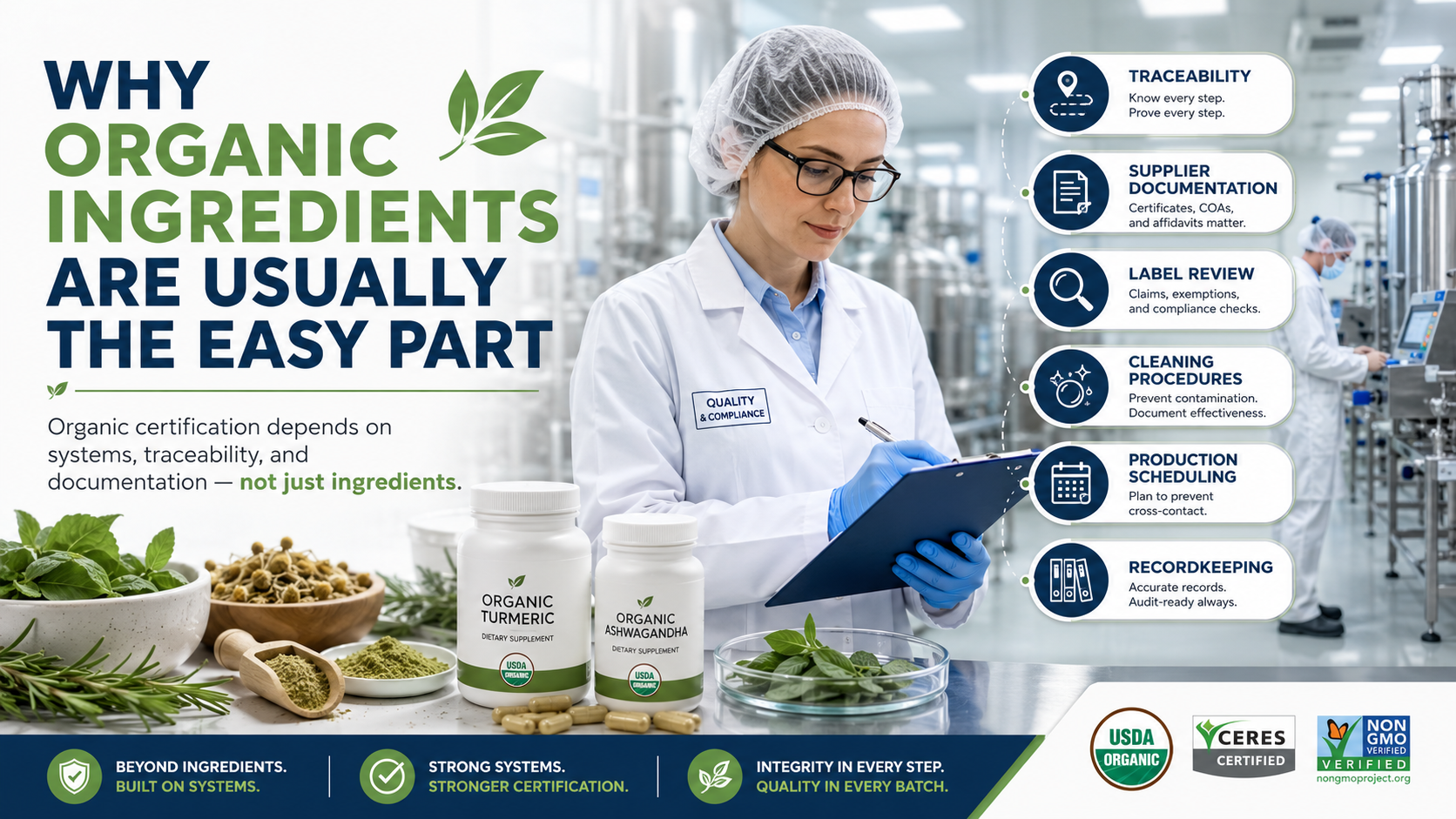
The headaches usually come from everything surrounding those ingredients. Traceability. Supplier documentation. Label reviews. Cleaning procedures. Production scheduling. And, inevitably, paperwork.
That's why two products with identical formulas can have completely different experiences when it comes to certification. One moves smoothly. The other gets stuck for weeks over issues nobody expected. And that's usually when brands realize that manufacturing an organic product is very different from simply buying organic ingredients.
Organic Ingredients Don't Automatically Create a USDA Organic Product
One of the most common questions we hear from brands entering the organic space is:
"If all the ingredients are organic, doesn't that automatically make the finished product USDA Organic?"
Unfortunately, no. And this is usually the first surprise.
USDA Organic certification isn't evaluating a collection of ingredients. It's evaluating whether the entire operation can maintain organic integrity. That includes receiving, storage, sampling, manufacturing, packaging, labeling, and recordkeeping.
In other words, the system matters just as much as the formula. Sometimes more. Because a product can contain perfectly acceptable ingredients and still run into certification issues if the documentation, handling procedures, or labeling don't support the claim.
Why "Mostly Organic" Doesn't Really Work
This is where many first-time projects become more complicated than expected. A formula may be straightforward. Suppliers may all be certified. Everyone assumes the difficult part is over.
And then the small things begin appearing. An outdated organic certificate. A supplier that changed certifiers. A missing linkage document. An ingredient coming from a different manufacturing site.
Individually, none of these things seem dramatic. Collectively, they can stop an entire project.
We've seen situations where the formula was finalized, packaging had already been approved, and production was scheduled—only to discover that the paperwork no longer matched the material being purchased. Nothing was wrong with the ingredient. The documentation simply couldn't support it.
Production doesn't really care. CCOF does. And that's usually when timelines begin slipping.
Why Organic Projects Rarely Fail During Inspection
People who haven't gone through an organic inspection often imagine inspection day as the most stressful part. Honestly, it usually isn't. From our experience, inspection day is often the easiest day of the year.
By the time the inspector arrives, most of the important questions have already surfaced. Supplier documentation has already been reviewed. Labels have gone through revisions. Handling plans have been updated. Traceability records have been checked. The hard work happened weeks—or months—before.
Which is why many inspection findings aren't really created during the inspection. They're simply discovered during the inspection. Inspections don't create weaknesses. They expose weaknesses that were already there.
The Real Audit Is Usually Traceability
People sometimes assume organic inspectors are primarily looking at products. In reality, they're often following paperwork. And if you've worked with enough organic inspections, you start to appreciate how much attention goes into traceability.
An inspector may start with a finished lot. Then work backward. Finished goods. Batch records. Ingredient lots. Receiving records. Supplier organic certificates. Shipping documents. Sometimes one small inconsistency is enough to trigger a much longer discussion.
That's why experienced manufacturers occasionally joke: organic inspections are really paperwork inspections. And honestly, there is some truth to that.
The question inspectors are trying to answer is surprisingly simple:
Can this product be traced completely and consistently?
If the answer is yes, things move quickly. If not, the conversation becomes much longer.
When "Clean Enough" Isn't Organic Enough
People are often surprised by how much attention organic programs place on cleaning and segregation. Most manufacturers already have cleaning procedures. But organic programs ask a different question. Not "Is the equipment visually clean?" but "Can organic integrity be protected?" Those aren't always the same thing.
Production scheduling matters. Material segregation matters. Cleaning verification matters. Preventing commingling matters. Especially in facilities manufacturing both conventional and organic products. Because once commingling occurs, explaining what happened afterward is much harder than preventing it in the first place.
The Day We Realized Labels Can Be Harder Than Formulas
This surprises almost everybody. Teams spend months discussing formulations. Then assume the difficult part is over. Sometimes that's when the real work begins.
Because labels have opinions too. USDA Organic seal requirements. Ingredient statements. Organic percentage calculations. Certifier references. "Made with Organic" claims. Everything has to align.
We've seen projects where the formula was ready, ingredients were available, and production capacity was open. Yet manufacturing waited because labels went through multiple rounds of revision. Ironically, the formula wasn't the bottleneck. The label was. And after enough organic projects, that stops being surprising.
Why We Work With CCOF
There are several USDA-accredited certifiers in the United States. For us, choosing CCOF was never about finding the easiest path. Quite the opposite.
Anyone who has worked with CCOF knows they pay attention to details. Sometimes frustratingly so. Over the years, we've found that CCOF inspectors tend to follow the details. A supplier name that doesn't match exactly. An outdated organic certificate. A linkage that requires additional explanation.
None of these things are particularly dramatic. But they force manufacturers to stay disciplined. And while that level of scrutiny isn't always convenient, customers tend to appreciate the confidence it creates.
At the end of the day, nobody remembers whether an inspection was easy. People remember whether the system held up.
Why Retailers Are Raising the Bar
Ten years ago, organic products were considered a niche category. Today, they're mainstream. Consumers expect them. Retailers expect them. Brands expect flexibility. Manufacturers are expected to support all three.
And much of the pressure is coming from the top of the supply chain. Large retailers, club stores, and grocery chains have invested heavily in organic programs. With that investment comes greater scrutiny. Retailers are expected to answer questions from consumers, investors, and regulators. Not surprisingly, those expectations eventually flow downstream.
Retailers push brands. Brands push manufacturers. Manufacturers are expected to demonstrate that the systems supporting organic claims are functioning consistently—not just during inspections, but every day.
Ten years ago, having organic ingredients was often enough. Today, customers increasingly want confidence that the operation behind those ingredients can withstand independent review. And expectations are only getting higher.
The Biggest Mistake We See
Most organic projects don't fail because the formula is wrong. They slow down because assumptions were made too early.
People assume suppliers have the correct paperwork. People assume labels will be approved quickly. People assume inspections are the hard part. People assume organic ingredients automatically mean organic products. And assumptions have a bad habit of falling apart when somebody starts reviewing records.
We've also learned that organic projects have a way of exposing assumptions. Unfortunately, those surprises usually don't appear when there's plenty of time. They appear when packaging has already been printed. Production has already been scheduled. And everyone is asking the same question:
"Why are we waiting?"
By that point, the answer is usually paperwork.
Preparing for an Organic Launch?
One thing we've learned over the years is that organic projects are much easier to build correctly than they are to fix later. Retrofitting organic requirements after formulas have been finalized and packaging has been approved is rarely enjoyable. And it almost always takes longer than people expect. Which is why we generally prefer having those conversations earlier rather than later.
If you're considering a USDA Organic product, the best time to understand certification requirements is before the formula is finalized and before labels are printed.
Contact the 4Excelsior Compliance Team to request our USDA Organic & CCOF Readiness Checklist and discuss your organic manufacturing goals.
Because the most expensive delays are usually the ones nobody saw coming.
Conclusion
People often think organic projects are about ingredients. After enough inspections, you realize they're really about systems. The ingredients are usually the easy part. It's everything around them that determines whether a project moves smoothly—or spends weeks chasing paperwork.
And anyone who's spent enough time preparing for organic inspections eventually learns the same lesson:
The product usually isn't what keeps you up at night.
The paperwork does.
About 4Excelsior
4Excelsior is a California-based dietary supplement contract manufacturer specializing in powder, capsule, and tablet manufacturing. Our USDA Organic program is certified through CCOF, one of the most recognized USDA-accredited certifiers in the United States.