Beyond GMP: Why Top Supplement Brands Are Rejecting Manufacturers Without SSCI Certification
A few years ago, most supplier qualification discussions in the dietary supplement industry were fairly predictable.
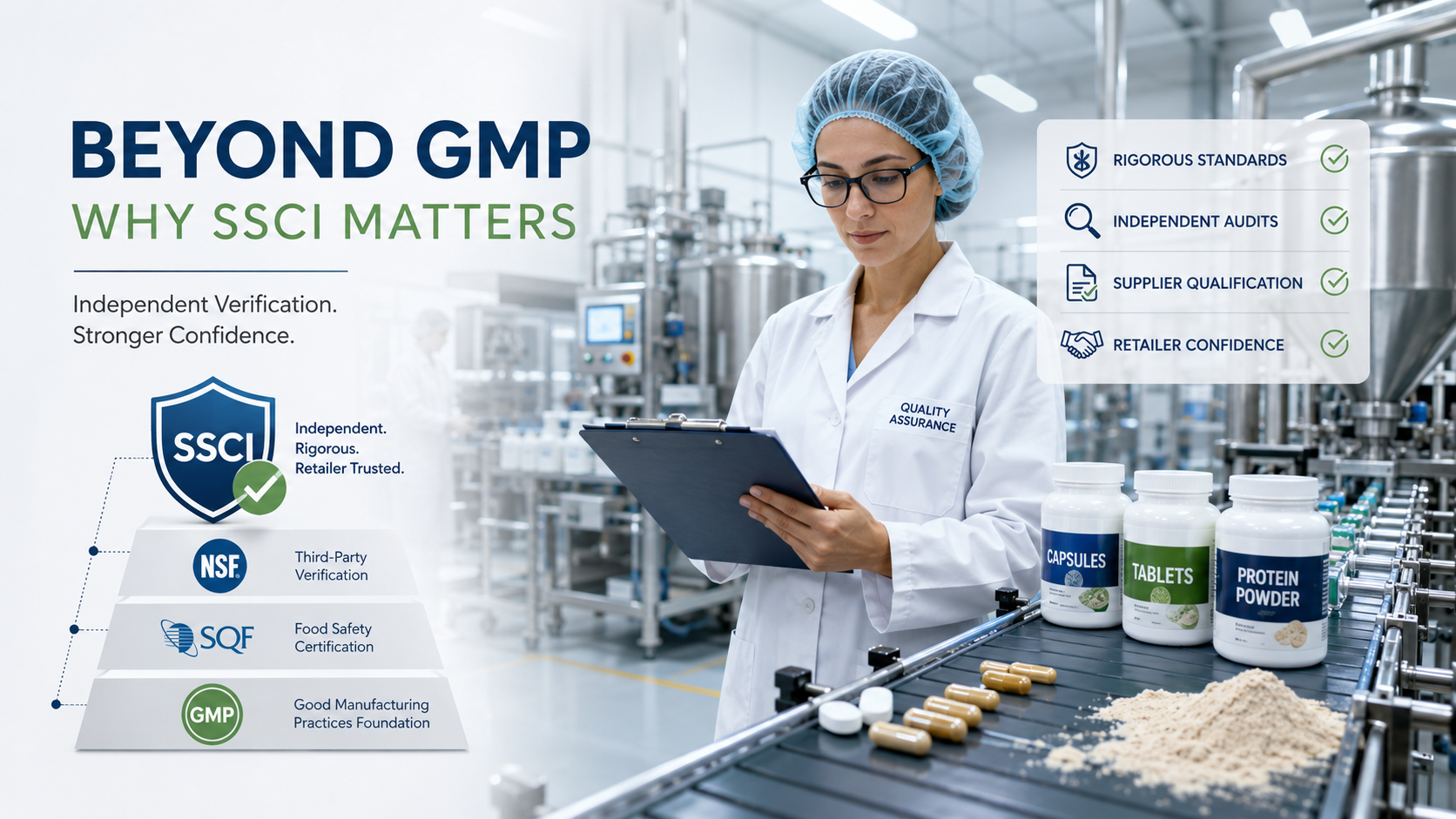
Customers wanted to know whether a facility followed FDA GMP requirements. Some would ask about NSF certification. Others might request SQF certification or additional quality documentation. As long as food safety, product quality, and regulatory compliance were covered, the conversation usually ended there.
That is starting to change.
Over the last several years, we've seen a growing number of customers ask about SSCI certification during supplier qualification reviews. In some cases, the request appears alongside GMP, NSF, or SQF requirements. In other cases, SSCI becomes part of a broader discussion about supplier approval and risk management.
For manufacturers, this often raises a simple question:
If we're already GMP compliant, why are customers asking for SSCI?
The answer has less to do with adding another certificate and more to do with how customers evaluate manufacturing systems today.
GMP Compliance Gets You in the Game. Independent Verification Builds Confidence.
One misconception we occasionally encounter is the assumption that GMP compliance and third-party certification serve the same purpose.
They don't.
FDA GMP requirements establish the regulatory foundation for dietary supplement manufacturing. Every legitimate manufacturer is expected to operate within that framework.
However, many customers are no longer satisfied with simply hearing that a facility follows GMP requirements.
They want independent verification.
From their perspective, the question is no longer:
"Do you have a quality system?"
Instead, the question has become:
"How do we know the system is consistently functioning as intended?"
That's where programs like SSCI begin to enter the conversation.
What SSCI Means for a Manufacturing Facility
One reason SSCI can be confusing is that people often associate it with social compliance programs or retailer-driven auditing initiatives.
In reality, what matters to most customers is not the acronym itself.
What matters is the confidence created by an independent assessment against recognized benchmarking requirements.
At 4Excelsior, our facility recently completed an assessment conducted by UL Solutions against the SSCI Technical Benchmarking Requirements (v2020), based on our GMP quality system and operational controls. The assessment covered the manufacturing, packaging, and warehousing of dietary supplements in powder, capsule, and tablet forms, as well as finished goods warehousing activities.
For customers, that type of assessment provides an additional layer of assurance beyond regulatory compliance alone.
The Real Question Customers Are Asking
In our experience, customers rarely ask for SSCI because they are interested in the certificate itself.
What they are really evaluating is risk.
When a retailer, distributor, or brand owner approves a manufacturing partner, they are effectively placing part of their reputation in that facility's hands.
They want confidence that:
- Procedures are being followed consistently.
- Training programs are functioning.
- Records are complete and traceable.
- Corrective actions are being managed appropriately.
- Quality systems continue to operate even when no customer is watching.
The certificate is simply evidence that someone independent has evaluated those systems.
The systems themselves are what matter.
Why This Trend Is Becoming More Common
A decade ago, many qualification programs focused primarily on product quality and regulatory compliance.
Today, customers have significantly more visibility into supply chain risk.
Retailers are under pressure from consumers.
Brands are under pressure from retailers.
Manufacturers are under pressure from brands.
As a result, supplier qualification expectations continue to become more structured.
We've noticed that customers are asking more questions than they did five years ago. They're reviewing more documentation. They're requesting more third-party verification. They're spending more time evaluating how facilities operate rather than simply looking at the products being produced.
From that perspective, SSCI isn't really creating a new trend.
It's a reflection of a trend that is already happening.
What is driving much of this change is pressure from the top of the supply chain.
Large retailers such as Walmart, major pharmacy chains, club stores, and national grocery retailers are under increasing scrutiny from investors, regulators, and consumers regarding supply chain transparency and supplier accountability.
As a result, those expectations are gradually flowing downstream.
Retailers push brands.
Brands push manufacturers.
Manufacturers are then expected to demonstrate not only product quality and regulatory compliance, but also broader operational maturity through recognized third-party assessments.
In many cases, SSCI benchmarking is part of that conversation.
Ten years ago, supplier approval was often focused on whether a facility could make a product correctly.
Today, customers are increasingly asking whether the systems behind that product can withstand independent review.
Where Facilities Usually Get Caught Off Guard
The biggest mistake we see is assuming that a quality system is strong simply because it has not experienced a major failure.
Most facilities don't struggle because of one catastrophic issue.
They struggle because of a collection of smaller gaps that were never fully challenged.
We've seen situations where procedures existed, training records were available, and operations appeared stable. Yet during an external assessment, inconsistencies emerged because records, practices, and expectations were not aligned as closely as management believed.
Nothing dramatic happened.
No product recall occurred.
No customer complaint triggered an investigation.
The issue was simply that the system could not consistently demonstrate control under detailed review.
That's often where improvement opportunities become visible.
Why We Pursued SSCI
For us, SSCI was never about collecting another logo for a presentation slide.
It was about providing customers with additional confidence in the systems that already support our daily operations.
Like many contract manufacturers, we regularly undergo customer audits, certification audits, supplier qualification reviews, and regulatory inspections.
Each of those assessments looks at the facility from a slightly different perspective.
The value of SSCI is that it provides another independent evaluation of the quality systems behind our manufacturing operations.
The assessment covered our GMP quality system and confirmed conformance with SSCI Technical Benchmarking Requirements (v2020).
From our perspective, that independent validation is ultimately what customers are looking for.
What This Means for Brand Owners
If you're evaluating manufacturing partners, SSCI should not replace GMP, NSF, SQF, or any other qualification requirement.
It should be viewed as another piece of information that helps you understand how a facility manages its systems.
The certificate itself doesn't manufacture quality products.
People, procedures, training, oversight, and execution do.
However, independent assessments can provide valuable insight into whether those systems are functioning as intended.
That is why more customers are asking about SSCI today than they were just a few years ago.
Conclusion
Most customers don't wake up looking for another certificate.
What they're really looking for is confidence.
Confidence that the facility can consistently manufacture products.
Confidence that quality systems are functioning properly.
Confidence that what is written in procedures is actually happening on the production floor.
As supplier qualification expectations continue to evolve, independent system assessments such as SSCI are becoming an increasingly important part of that conversation.
For manufacturers, the question is no longer whether customers will ask for more transparency.
The question is how prepared you'll be when they do.
Preparing for Retail Expansion?
Entering mainstream retail channels today often requires more than GMP compliance alone.
Whether you're preparing for retailer qualification, responding to customer audit requirements, or evaluating supplier compliance expectations, understanding SSCI requirements early can help prevent costly delays later.
Contact the 4Excelsior Compliance Team to request our SSCI & GMP Readiness Checklist and discuss your retailer qualification goals.
Because the best time to prepare for a compliance requirement is before a customer asks for it.